Sunday, May 6, 2018

Genius Hour in French Immersion: An updated reflection


       A few years ago, I wanted to implement Genius Hour (aka. Passion Projects) in my room but things kept falling flat - see my post here. I found it difficult for students to research because they lacked the research skills, there were very few books and websites in French, and my student’s reading levels did not match the ones that did exist. Kids were having fun through play, but I felt something was lacking. I have continued to tweak how I approach Passion Projects with each new class. Here is my current process.

My Genius Hour is currently maker/STEAM/crafting/coding/exploration time. I would love to include the free inquiry model with driving questions, but as of now it is play-based.  Students are engaged, on task and communicating in French spontaneously, but the stuff they are working on is not necessarily connected to a curriculum expectation. It has taken a while, but I have come to accept that it is ok.

At the beginning of every session, we gather as a class and each student decides on what they would like to explore with “Je peux…” statements or “Comment” questions. They can work alone, in pairs or in groups. The goals of our Passion Projects are to 1) Learn Something New, 2) Speak in French and 3) Have Fun. Students are committed to creating/making/experimenting their chosen project for that time period.  They are expected to be speaking in French the entire time as they create and collaborate with their peers and they are expected to write about what they learned the next morning in their Passion Project Scrapbooks. Students have created class stores, learned how to code, built homes for their toys, written storybooks, controlled robots, created songs and vlogs and use the green screen - all in French. Keeping consistent evidence of student  learning, however has been difficult, but engagement is at a maximum. I still would like to tweak this further. I would also like to incorporate the Four Pillars of Inquiry using Trevor McKenzie’s outline. 

Our Library Technician has recently started a Maker Space time in the Library each week, which is an overlap or repeat of what we have already been doing in our class - except the level of French is reduced. If this opportunity continues in the library for my future students, I will need to re-evaluate how this time is spent in my classroom, in an effort to not double-up.

Connection Passion Projects into my Literacy Block
Because the actual Passion Project time itself is "not related" to anything, I felt needed to connect it back into my literacy block. Students maintain their own Passion Project Scrapbooks where they record information, gather ideas and recount what they have worked on. We did heart maps and hopes and dreams lists in our Writer’s notebooks at the beginning of the year, and revisited them again mid-year to help guide our Passion Projects. They listed things they like, can do, want. They also generated questions about food, nature, animals and technology, as well as listing possible project ideas. They keep these lists in their Passion Project Scrapbooks in case they run out of ideas. 

       Students have the opportunity to share with others in the form of a formal presentation, in conversation opportunities and internally and globally through our kid-friendly class app “Seesaw”. We have also made displays in and out of the class and invited others in to see.  

The following outlines the choices my students have during self-selected literacy centres- with Passion Project options woven in. While they do one of the following, I meet with small Guided Reading groups. I have separate times for Conversation/Interaction practice, Writing Workshop and Independent Reading. Word work is woven throughout. Students may not “make” during this time.


Some free resources for you:


My next steps


  • Effectively find away to assess my students throughout the inquiry processes
  • Add student goal setting and reflections to Passion Projects
  • Transform Passion Projects into Free Inquiry
  • Focus more on empathy when creating driving questions and design tasks
  • Reach out to the community for my students to find “local experts” - perhaps some skyping?
  • Don’t get bogged down with coverage or content (EQAO!!!). Slow down my teaching to allow students to their deepen understanding and allow more time for rich and meaningful reflection.
  • Reflect on my teaching practices (And revise as necessary)!

Inquiry-Based Learning in French Immersion: Part 4

For the 2017-2018 school year, our school was awarded a grant for The Teacher Learning and Leadership Program (TLLP).

TLLP Goal #3
Find and put into action French resources suitable for FI students to use during the inquiry-based learning process.

The following items are French resources I use. 

  • I became a DELF “correctrice” this past summer through the Centre International d'Études Pédagogiques (CIEP) which allows me to administer and score DELF tests for our board. I use my knowledge of the A1 qualifiers to drive my classroom listening and speaking instruction - with a focus on asking questions.
  • I ordered a variety of non-fiction texts for my classroom with our TLLP grant to engage and pull new questions out for and by my students. They primarily connect to grade 2-3 Science and Social Studies expectations
  • Local High School classes created some high-interest fact sheets for our students for reading and listening - related to   lists of interests our students provided to them. 
  • I created my own fact sheets for students to use during Controlled Inquiry projects in order to ensure they could  read the facts and to avoid “translating stuff on the Internet”
  • I was part of a team who has been creating a new Writing Tool for French Immersion teachers that  connects the CEFR qualifiers to the Achievement Chart of the Ontario Curriculum. This tool will help assess a variety of different writing tasks suitable for inquiry-based learning. The members of our TLLP project have been piloting this assessment tool
  • I continue to use GB+ Trousse for Reading assessments and co-created success criteria for speaking and listening assessments. This continuum guide has been very useful to me. I use evidence of Conversation, Observations and Products to assess and evaluate my students.


TLLP Goal #4
Share what we learn with French immersion teachers within our school and school board who would be interested in learning how inquiry-based learning and technology can be implemented in their classrooms.
As a whole, the TLLP project has been a very rewarding experience. I was given a lot of time to reflect on my current practices and to try new things. We were able to regularly collaborate with our French Immersion colleagues and had a generous grant to purchase things for our classrooms. 


If you have any additional questions, please visit our TLLP blog: http://bit.ly/inquiryfi You can also email me Lindsay_Wright@bgcdsb.org

Inquiry-Based Learning in French Immersion: Part 3

For the 2017-2018 school year, our school was awarded a grant for The Teacher Learning and Leadership Program (TLLP).


TLLP Goal #2


To develop knowledge on how to best integrate technology appropriately and effectively with inquiry-based learning

This TLLP goal has been the most challenging for me. For anyone who knows me at all, I love technology and I am quite savvy with it. Our classroom is equipped with Chromebooks, ipads, ipods, a SMARTboard and a collection of different robots and coding devices. We use the SeeSaw app to share our work online and listen we to music and watch French videos. We listen to audiobooks and collaborate with Google Docs with our own classmates and beyond. We play math games and learn to code, we produce music and make stop-motion videos and iMovies. 

In theory, I would love to fully integrate technology into my classroom - especially to support the inquiry-process, and general innovative practices, however, the past couple of years a trend has been emerging in my primary classroom that worries me and I have in fact, been trying to simplify things and actually embrace less technology. Many of my students in my classroom are exposed to excessive screen time outside of school, and I feel that too much technology at school is making it worse. New behaviours have emerged around technology and self-regulation is becoming more and more difficult to manage for some children. 

Technology does not equal inquiry. Nor does it equal innovation. It is a tool that can be used to support this, but not to replace sound instructional practices. Instead of purchasing too many more technology items, I bought more lego sets and building blocks and rainbow looms and button makers. I used money for flexible seating options, and consumables (duck tape, glue guns, fancy paper and paint). And books. Lots of books to engage and generate questions. 

I will still continue to use technology as I have been, but only as a tool. My goal is to reach students on a more human level. To talk, to interact, to question, to problem-solve together, to debate, to present. This is the very essence of a Second-Language classroom.

Inquiry-based learning in French Immersion: Part 2

For the 2017-2018 school year, our school was awarded a grant for The Teacher Learning and Leadership Program (TLLP).


TLLP Goal #1
To gain a solid understanding of the inquiry-based learning process and ensure that French Immersion curriculum expectations are being met in speaking, listening, reading and writing.

    A few years ago, I wanted to implement Genius Hour in my room but things kept falling flat. I found it difficult for students to research because they lacked the research skills, there were very few books and websites in French, and my student’s reading levels did not match the ones that did exist. Kids were having fun through play, but I felt something was lacking. Late primary students are a unique group, who are able to work independently and are easily engaged, but still require constant (and very direct!) teacher guidance to keep them on track. I realized that I was throwing them into the “deep end” without the scaffolding they needed to succeed.

    For honing in on a more precise inquiry model in my room, I have been using the inquiry cycle model as laid out in Trevor McKenzie’s Inquiry Mindset”. This a process where students are involved in their learning, create essential questions, investigate widely and then build new understandings to answer their question, to develop a solution, or to support a point of view. The new learning is usually presented to others publicly and may result in action. - Alberta Focus on Inquiry, 2004.

    Reading Inquiry Mindset gave me a clearer definition of what “inquiry” actually is. I also discovered that I was already doing plenty of inquiry without actually calling it inquiry. Here some examples of the inquiries my class did this year based on the “new” titles:

STRUCTURED INQUIRY: Les Olympiques: a Social Studies + Current Events Inquiry - 

  • I chose the topic (Olympics)
  • I used a "hook" video
  • Students generated related questions (whole class)
  • Each day we answered a new question. I did the research on the SMARTboard using a kid-friendly Olympic webpage (Chrome extension to translate the pages into French)
  • I answered the questions and modelled how to pull out information
  • We did Interactive Writing to answer the questions
  • We looked for photos, did medal counts, watched live feed, researched continent locations, larned about Team Canada ("Je me présente" cards), played gym-adapted Olympic sports, made a display.
      This Structured Inquiry went over well with the kids. They were hooked from the mascot video. They easily generated questions that were important to them (and ones that I anticipated!). It was great walking students through a research method (reading a French website for important information) using appropriate fluency and for keeping students engaged and on task. It generated great discussion and perfect short texts for Interactive Writing pieces. Students were inspired to learn more outside of the classroom at home and reported back new findings for our class display. Next steps: I did not assess students with a culminating task, only observations and conversations throughout. Next time I might add a task for students to “show what they know” independently.


CONTROLLED INQUIRY: La Croissance des plantes: A Science Inquiry


  • I chose the topic (plants)
  • Students generated related questions
  • In pairs, students chose one of the related questions to research further
  • I created research "info sheets" and posted them around the classroom
  • Partners walked around room and "researched" their question from from the posted information
  • I decided how they would present their findings (a poster presented orally to the class). We put the posters up in the hall for others
  • Students self- and peer-assessed

After many hands-on science experiments with plants and soil, this Plant Controlled inquiry went well, students were able to complete the project quickly and successfully. They also researched by themselves and created a representation of their learning. Next time, I will add a QR code with an audio link that will help make the text accessible to all students.


GUIDED INQUIRY: With my basic training from Future Design School, we asked some “How Might We?” questions. Inquiries ranged from basic to more complex design-thinking tasks. These are like a Guided Inquiry. This process has students learning to empathize, define, ideate, prototype and test designs. Some questions worked on include: How might we design a stable structures that uphold a force? How might we learn from early Canadians to improve our own community today? How might we teach younger students how to add big numbers in their head? How might we celebrate our school secretary? How might we convince Mr. Walsh to let us have a party? How might we design a product that honours St. Joseph? How might we teach others about Residential Schools?

FREE INQUIRY: We are not quite there yet (See my notes on Genius Hour here).

Although these are new terms introduced to me this year, they all very closely relate to other things our board has been implementing in other avenues for many years. 
  • Open-Ended Questions in Math: Open-Ended Questions are a very important part of my numeracy block derived from key learning in my years of Math CILMs & PLNs. Although carefully worded and somewhat directed, Open-ended questions, generally don't have a single right answer. Instead, they're meant to encourage students to start a discussion or think creatively. They allow them to think more deeply and critically about their response and to use extended vocabulary to express their ideas. Deeper thinking can be scaffolded by inviting children to “show” what they mean and “tell you more” about what they are doing.
  • Action-Oriented Tasks in FSL: Although this approach does not primarily revolve around questioning, by embracing an action-oriented approach, I draw upon student interests and make connections to the curriculum to develop purposeful tasks. I often use open-ended questions to guide these meaningful authentic situations and encourage students to develop questioning strategies as they participate as social actors.
I really like the set-up of a defined inquiry circle. Even if I am usually the one developing the driving question, students still have the opportunity to ask many of their own questions to drive the inquiries.

Empowering French Immersion Students through Inquiry-based learning

       In my classroom I try to allow for my student’s questions, wonderings, ideas, observations and thinking are at the centre of the learning, without losing sight of curriculum expectations. Over the years, I have dabbled with Genius Hour and STEAM challenges (as referenced in my blog posts here and here), and have always used flexible seating (another post here). Students have choice in how they work, where they work, who they work with (sometimes) and how they present their work. Trying to engage the stage and differentiating personalizing student tasks are not new practices for me in my classroom and I have always been open to try to learning, implement new ideas and keeping the creativity of students alive throughout the day. 


For the 2017-2018 school year, our school was awarded a grant for The Teacher Learning and Leadership Program (TLLP) - an annual project-based professional learning opportunity for experienced classroom teachers in Ontario. Our school team of French Immersion Teachers, ECE and coach, under the direction of classroom teacher Philippa Miller, is investigating the Inquiry-based learning process with our Primary, Junior and Intermediate French Immersion students. The following if a summary of our TLLP goals, and where I fit into the project as a late Primary (Grade 2 and 3) French Immersion Teacher.


TLLP Goal #1:   Click here
To gain a solid understanding of the inquiry-based learning process and ensure that French Immersion curriculum expectations are being met in speaking, listening, reading and writing.

**Updated informations on my Genius Hour/Passion Project time **

TLLP Goal #2: Click here
To develop knowledge on how to best integrate technology appropriately and effectively with inquiry-based learning 

TLLP Goals #3: Click here
To find and put into action French resources suitable for FI students to use during the inquiry-based learning process. 

Sunday, October 16, 2016

Flexible Seating in Late Primary

This year I decided to go without assigned seating. No individual desks for each student.

For years I've made cute name tags, arranged my desks in groups and rotated the seating arrangement the first of each month. Throughout the day, students were free to work wherever they wanted on reading or writing or math or anything really. I had a "where can I sit?" rotation board with many flexible seating options, but they always had a home "base" of a desk to keep their materials and for lunch and art.

Why the change?
Too many papers. Moldy food. Extra toys and papers and forgotten work. Entire collections of Shopkins and mini pencils kept in the desks. I had had enough. The room always seemed really crowded.

I still couldn't wrap my mind around how the first day of school would go though. Or how lunch would happen or painting in art. I actually wasn't planning on going "deskless" until the week before school when I was physically setting up my room. There was just so much more space.

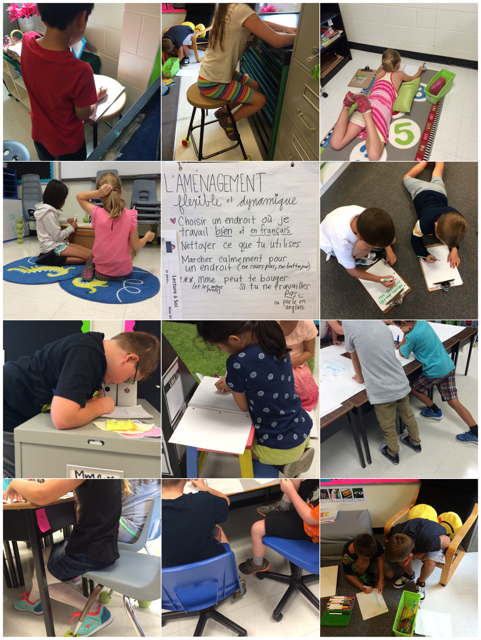
In my grade 2/3 class, we still have 20 desks, but we are using them as tables for other things. We have seating around one big group of desks (for maybe 10 kids?) if they want. We have 3 large carpet spaces, lots of pillows and stools, big stuffies, 2 rocking chairs, some mini carpets, crates and lower shelves. We have rolling chairs and regular classroom chairs. We have way more seating options than students.

So.... how does it work?
Anytime I have a mini-lesson to teach or a class meeting or activity, we sit together as a class on the carpet. No pillows or chairs or toys in our hands. Carpet time is strictly carpet time. Listening to instructions, or a mini lesson, or participating in our morning meeting or Meditating. If we are using the SMARTboard, students will pull up a desk chair for better viewing. Once students are free to "get working" in pairs or groups or independently, they can sit were they work best. If they aren't working smartly (or speaking too much English),  I have the right to move them to a place where they will work better.

Each student had a couple of hooks and a basket assigned in the hallway, a cubby space for their lunch in the classroom and a book bin to keep their pencil cases, independent reading books and writer's notebooks. I keep their math books and religion and science scrapbooks on another shelf. They also have mailboxes. Shared pencils, markers, rulers, glue sticks, scissors, white boards, paper, technology etc, are found in various locations around the classroom.

Any challenges?
- The rolling chairs. Ugh. Still a constant reminder not to use them as cars. (this isn't a new challenge. I've had rolling computer chairs forever.) Time will help.

- I would really love to have a space to leave kids notes of encouragement. I used to write notes directly on their desks with white board markers and they had reading/writing goals taped to surface. I still need to think of a creative way to continue to do both of these things.

- I would like to do a bit more research to see if writing on the floor is ideal for fine motor skills (some have pretty poor penmanship). Je ne sais pas.

- We've done painting in small groups (4-5 kids) along the side shelf. That seems to work, but I am still apprehensive of the space to do whole-class painting all at once.

- Eating lunch isn't really ideal without desks for everyone. I don't like the mess they leave all over the room (crumbs, wrappers etc) when I am not in the room during eating times - regardless of how much we practice. They also wander a lot more. I am thinking I might get them to sit in a circle on the carpet only. I haven't decided. I need to think of a better system.

**- Some kids are still asking "when do I get my own desk?". Some really miss and value their personal space. Some also just brought a whole bunch of unnecessary (and unasked for) binders and stationary and have no where to put it all. (Bring it home kiddies!). Regular desks + chairs are (interestingly) one of the more popular spots to sit.

Do you have a standard desk for each of your students? Are you deskless?
What are your biggest successes and biggest challenges?
Do you have any tips for lunch?

Wednesday, August 3, 2016

Sketchnoting the Innovator's Mindset: Chapter 2

I am sketchnoting my way through George Couros's The Innovator's Mindset: Empower Learning, Unleash Talent and Lead a Culture of Creativity using the Paper app and Musemee Notier Prime stylus.


Chapter Two had a good refresher on Growth Mindset - a school-wide goal we adopted a couple of years ago. We did quite a bit of reading from Carol Dweck (and others) about the elasticity of our brains and the ability to develop our intelligence, talents and abilities with hard work and practice. We did a lot of teaching around Growth vs. Fixed mindset with our staff, students and parents - including strategies on how avoid having a fixed mindset. Here are some examples of anchor charts I made with my kiddos in previous years.


I appreciate how George has added the element of innovation to the idea of Growth Mindset. It isn't enough to just learn - but let's take our intelligence, abilities and talents further by creating something new and better

I like the idea of the Innovator's Mindset. I also know, that we have a lot of work to do with our students around Growth Mindset. There are still many students (and teachers, and parents) who are not convinced that they are able to develop their skills, intelligence, abilities and talents any further. As well as those who already "know it all" and think they are the smartest in the class. 

Do you think that we need to develop a Growth Mindset before we can develop an Innovator's Mindset? Or do they work hand in hand? Is innovation the reason we want to develop our abilities, intelligence and talents?

@mmewrightfi

One of the key ideas from this chapter that stuck with me was the importance of failure. Failure is important for the process, but failure cannot be the final outcome. High Expectations are still important. It is crucial to come back from failure with resiliency and grit: two traits that are difficult for many young people who haven't had to wonder, investigate or create - as everything has been done for them. Although failure is important, it cannot be accepted as the final outcome. This will cause tears of frustration, anger and disappointment (by students and teachers). It will cause parent phone calls with many concerns and questions. This will cause excitement and creativity and innovation.

I will continue to teach my students about brain elasticity and Growth Mindset. I will to add the element of an Innovator's Mindset - and build in lessons about resiliency, perseverance and grit. We will create new and better ideas.

*
Did you miss my sketch note for Chapter 1? Check it out here.

Innovation is not about the stuff. It is a way of thinking. #innovatorsmindset 

Tuesday, July 19, 2016

Sketchnoting The Innovator's Mindset: Chapter 1


As introduced in my last post, I am sketchnoting my way through George Couros's The Innovator's Mindset: Empower Learning, Unleash Talent and Lead a Culture of Creativity using the Paper app and Musemee Notier Prime stylus.


As George mentions, the word "Innovation" gets thrown around a lot in education. In recent months, I have heard people use the term INNOVATION interchanged with inquiry, creativity, exploration, invention and "using more technology". It can be all of that, or none of that. Innovation is really just a way of thinking that creates something new or better. This chapter gives readers a better idea as to what Innovation is and what it is not. 

George asked 3 questions at the end of the chapter. This one of them:


The answer to this is definitely a work in progress. It is a hard one. I have a few new goals for September in my brain right now, and need to draw and plan them out soon. I tend to mostly focus on how I can bring innovation and creativity into my classroom as a teacher through engaging tasks that promote problem solving, collaboration and critical thinking, and how to get my students to take risks, ask questions, and gain a sense of wonder, motivation and growth mindset to develop creativity and innovation themselves. But, in my leadership? In my own learning? 

I have always thought of myself as a creative, but never an innovator. 
I need to push my boundaries, stretch my thinking, make growth manageable and embrace the new.

Some things I will be working on in the fall for my teaching: 

- Teaching the whole kiddo. Physical, mental, spiritual. Make sure they know they are important, what talents and strengths they offer the class. Growth Mindset and student-led classrooms. Really get to know each student. "The question that must be asked every day is, "What is best for this learner?"

- Collaboration + Communication en français (with each other, local communities and the world - continue conversation, kidblogs, etc.) Rich, authentic, action-oriented tasks.

- Passion/Wonder Projects - Make a plan to improve from last year.

- Create a maker space/provocations/invitations to learn - how do I incorporate throughout the day? Do students visit area whenever they feel like it? During a certain time? In rotation?

- Create more flexible seating options

- Mix-up my literacy and math block. They work. Students are definitely learning, collaborating and taking risks with open-ended tasks - but are they being innovative? I'm not sure. Worth looking into. 

 - Add more engineering challenges, the ARTS, coding, mystery skypes and edCAMP 

*

When we thinking differently about the things that we are used to seeing daily, we can create innovative learning opportunities. #innovatorsmindset 


Tuesday, June 28, 2016

STEM in the primary FI Science room

This year I totally "revamped" the way I teach Science. Teaching younger students than I'm used to (grade 2s with the 3s), I knew I couldn't have them write up lab-reports. We needed to get right to the science. I also knew that their attention spans are a lot shorter and they get distracted easily. I also needed them to practice their French speaking more than their French reading & writing.

With the STEAM movement back in full swing again, I decided to do a series of open-ended engineering challenges. I wanted the students to really understand the curriculum expectations by exploring them first hand. Here are some of the activities we did.

Grade 3: Ontario Curriculum: Strong + Stable structures

- Task 1: Build the tallest structure that can hold a tennis ball (using straws and tape)
Task 2: Build the strongest structure (using popsicle sticks, coffee stirrers and tape)
Task 3: Build the strongest structure (using cups, sticks, straws, tape)
Task 4: Build the strongest structure (using only index cards - no tape!)
Task 5: Build the strongest bridge between 30cm desks (using straws and tape)
Task 6: Build the strongest boat (using aluminum foil)
Task 7: Build the strongest and most stable structure to survive hurricane (fan) and earthquake (shaking) (using any material they can find)

For each challenge we used different weighted objects to measure strength. After each challenge, we gathered together to talk about why the "winning group" won. What made their structure stronger? What made their structure more stable? Students pulled out all sorts of learning and concepts - and applied them to the next challenges. (ex. struts, ties, beams, solid base, etc.)

In between the challenges, students led conversation about what else they were wondering about strong and stable structures. They talked about stable vs. unstable, animal built vs. natural vs. man-made structures, what materials make the best structures, the tallest towers in the world and how weather can destroy structures. Ta-da! They unpacked the curriculum right in front of me. It was pretty awesome. Anecdotal notes, student wonderings and reflections, coupled with a Kahoot! quiz helped give me some great assessment data. I really knew they knew it.


Grade 3: Ontario Curriculum: Forces Causing Movement


-Task 1: Design your own catapult or slingshot that using elastic force and will pass a series of tests. (ex. materials: spoons, elastic bands, tape, cups, binder clips, popsicle sticks, straws…)
           Test 1: Accuracy: (fling pom poms into a hat from a distance)
           Test 2: Strength (fling large bead at a cup tower from a distance )
           Test 3: Distance (fling mini marshmallows as far as you can)

- Task 2: Make the toy car go down the ramp the slowest. (change the friction) (Materials: a variety of types of paper, rubber bands, sticks, straws, felt, cloth, tape…..)

- Task 3: Design a maze (straw pieces + card stock).  Use magnetic force to move an object through it

- Task 4Push a pop can at least 10 metres using only static force. Race!

- Task 5: Test your muscle force in a series of exercises: tug of war, arm wrestle, push-ups, monkey bars. Students also threw a variety of different size/weighted balls

- Task 6: Design and create a gravity marble run/roller coaster (Materials: paper bowls/plates, paper tubes, cardboard, cans, etc.) -- THEN market your coaster with an iMovie trailer advertisement.

Throughout these tasks, students had many conversations around questions like these (taken from Ontario Curriculum Document). Would using two magnets instead of one to pick up pins be better? What would happen if you put more people on one side of a tug of war game? What would happen if you rubbed a balloon on your sweater? Would it matter if you rubbed it 5 times or 10 times? Why should you use a seatbelt in the car? or knee and elbow pads and wrist guards for roller blading? helmets for cycling and hockey? Sport shoes designed for basketball?

I was right. Students loved science this year - always asking for more. They learned a lot. 
I am definitely going to continue keep Engineering Challenges in my Science lab.

    Friday, June 24, 2016

    Reflection: Passion Projects in French Immersion


    On my Maternity Leave with Abby, I got caught up on a lot of professional reading that teaching full-time with kids at home doesn't leave much time to do. I read books and blog posts and articles about Student-Led classrooms, I joined an online book club with other readers of Paul Solarz' Learn Like a Pirate and and jumped head-first into the twitter conversations, chats and live binder about Genius Hour and 20-time and maker spaces. My husband Rob (also a Primary French Immersion teacher) and I collaborated a lot, reading and reflecting together. He was the "guinea pig" to test out some of our learnings in his classroom to get out some kinks.

    Coming back to school this past September, I was ready to dive right in, using Rob's successes with Genius Hour in my back pocket. We have always done project-based learning in Social Studies, Science and Art, and my students thrive on open-ended choice in Literacy and math, but I wanted to give students even more freedom this year. But, as we know, reading about stuff in theory isn't always quite the same as it is when put into practice.

    Genius Hour/Passion Projects in the Primary French Immersion Classroom

    We started the year talking and talking and talking and talking some more about ourselves, our families, our likes and our dislikes in staged and authentic, real-life situations. It is crucial for my students to understand and use familiar everyday expressions and basic phrases, and interact with one another in French. "Je me présente" is the first major focus for my students based on the Ontario Curriculum and the Common European Framework (CEFR).

    Late September, I introduced students to our Mur des Merveilles (Wonder Wall). I asked them to think about all of the conversations we've had over the last month about their talents, their likes/dislikes, things they want to know more about. They could add as many wonderings as they wanted.

    Bring on the tears.

    This did not go well. Not even a little bit. "I don't wonder about anything." "I don't know." Lots of crying. Lots of absent-faces. I thought kids were supposed to wonder about everything!

    At first I thought it was because I was having them write their ideas, so I gave them the option to draw it, and to talk to their partners... and to audio or video record their thinking. More of the same. Crying. Blank stares.

    I decided to keep going. Rob said he had a lot of success last year with his grade 3s. I showed them a powtoon en français to introduce the idea of Genius Hour: Time every week they can explore, tinker, build, create, play with anything they'd like.

    I started having Genius Hour every Friday. We talked about asking good questions and different ways they can present their learning to the class. They had a little log-book to record the information or ideas they had and research they might have found. They were supposed to check-in every once in a while to see the progress. Whenever they were ready to present their findings or new learning to the class (with any sort of "product" they wanted) they could. It was completely open-ended - without any real restrictions.

    Again. In theory, sounded great! Kids were supposed to be engaged, discovering new things, playing and building. It didn't really work out that way. Many kids lost the log-book, couldn't figure out what to do, changed their minds every class and many couldn't follow their project to a product. People forgot passwords for computers and apps, fought over materials - and most of it was hoarded, destroyed or stolen.  But I kept on plugging. I had to find success.

    The first round of projects were simple - there were posters about friends, animal projects, a science experiment and some crafts. Those who finished seemed pleased with their work, but not necessarily excited about it.


    Along the way, I changed things up. Students didn't have to record any writing along the way anymore, only a 3-question reflection at the end about what they had learned. Peers gave feedback as well. I also changed "Genius Hour" from every Friday to a Literacy choice during our Language Block every day.

    Things weren't that much better. I kept asking myself. What is the point of doing this? Is it because it is truly engaging my students or improving their French in ANY way? The answer was no for both. I felt that I was the English Police, students weren't collaborating, and the products they were making were not anything to write home about. Students didn't really speak while presenting either, just read the franglais from their work and their peers were disengaged.

    The projects in round two (which again took FOREVER to finish for some), were mostly prezis slapped together with English youtube videos of Bieber or Skateboarding. I was pretty disappointed.

    I changed things again.
    I went back to a specific time to work on Passion Projects, as I felt many students were not choosing to work on them during Language block. I brought in more materials for exploration. I simplified the expectations further to 3 guidelines (1. You have to learn something new, 2. They are fun!, 3. Must be in French. I put up a grid on my chalkboard where students had to choose a question and stick with it. I explained that I was not ok with a prezi slapped together with videos and expressed many, many, many times that they had to learn something new.


    This time around, there was more of a variety of ideas - but still kids still weren't really excited about them. They worked on it, but got distracted with other activities we were doing in class. More students, however, were making sure they were learning something new. One student wanted to create their own game within Roblox - which is amazing. He spent his time watching youtube tutorials on how to do it and then created his own working game, shared on his blog and other kids played it. He was proud. He was excited. I was really impressed. So much learning. BUT.... all of his research was in English. There was no French learning. Not even a little bit. This is the problem.

    ---------
    So, will I do Passion Projects again next year? ABSOLUTELY! - but with a lot of changes.

    Biggest Issues:
    • Students are not reading in French if they choose to research something online
    • (Most students can't read independently at "Internet" reading levels anyways)
    • Students don't have appropriate log-in information for computers or knowledge of researching
    • Students are taking too long to make a "product" to display learning - losing interest
    • Students are not using feedback from teacher or peer
    • Students are not staying engaged
    • Students are not practicing listening, speaking, reading or writing in FRENCH

    What can I do the same?
    - Keep doing project-based learning 
    - Keep doing STEM projects in other subject areas
    - Keep open-endedness of wonderings
    - Keep Kidblog/sharing & reflection requirement
    - Keep teacher & peer feedback

    What can I do differently?
    - SCAFFOLD. More. Way more. Way, way more. Even though they are late primary. They still need gradual release. Even with this.
    - MORE explicit teaching of growth-mindset and perseverance
    - Spend more time with more explicit teaching on how to wonder....? What to wonder about?
    - Create a perpetual-always-changing "Maker Space" with opportunities for tinker time. Creation/Invention and provocations (get rid of the "project" part until later in the year?)
    - Give students more guided tasks first (“everyone invent a….”) before "project" part
    - Find research for kids who need it in French....? (does that take away from inquiry? Not sure.)
    - Bring in some French-speaking volunteers to help during Genius Hour
    - More consistent check-ins and conferences with me (Add accountability partners?)
    - Introduce to more product options/apps so they don't always choose the same thing

    French Immersion is unique. Late primary students are unique. I need to figure out what my GOALS are for doing Passion Projects. I think my students understand the goal. But I don't. This is likely why I didn't see the success I was hoping.

    Am I doing Genius Hour to engage them more?
    (Primaries are usually already excited about everything)

    Am I doing Genius Hour to improve their French Speaking/Listening/Reading/Writing?
    (It would be nice, but it doesn't seem to be.)

    Am I doing Genius Hour because it is popular & trendy? (Maybe.)

    I totally loved doing Design & Technology and Visual Arts when I was in Elementary & High School myself. It was my favourite time of day. Anything creative. I would totally love this stuff if I was a student. Am I doing Genius Hour for me? (Maybe.)

    I need to figure this out. With the students at the centre.
    I can't wait until September!
    xoxo

    (Any and all feedback is welcome)

    **I wrote a 2018 Update on Genius Hour here**


    Wednesday, April 13, 2016

    Door of Mercy: Collaboration at it's best


       On December 8, 2015, Pope Francis opened the Holy Door of Mercy in the Basilica of St. Peter, marking the official start of the Jubilee Year of Mercy. A few days later, he presided at the opening of the Holy Door at the Archbasilica of St John Lateran. 
        Inspired by Toronto Catholic District School Board's Doors of Hope - an installation of 140 painted doors in celebration of the 100th anniversary of Catholic Charities of the Archdiocese of Toronto - The Bruce-Grey Catholic District School Board invited our schools to artistically represent a theme of mercy on a door. 

         We drew out some ideas and decided that in addition to "mercy", we needed to represent out school. I was honoured to be chosen to put ideas into fruition. Our door included the medicine wheel and feather to represent our close connection with Saugeen First Nation (and the students they have entrusted to us), the white lily and ruler to represent St. Joseph the carpenter, and both French, English and Anishinaabemowin languages. Every class created it's own Ray of God to show that we are all connected and loved by our Creator.
     Let our hearts be led by Mercy. Help us reach with open hearts and open doors.


    Thursday, September 3, 2015

    Faith Formation Day

    Just some notes from Faith Formation Day this year. Two very inspirational speakers. Love it.
    What's YOUR vocation? #BGYouAreCalled @Fr_Toby @FrKuzma


    Monday, September 1, 2014

    To my KPS teachers

    Forever and ever I've been wanting to contact my teachers growing up - but I haven't. Three things recently made me remember that: 1) a student mentioned that she is currently writing letters to her teachers (she just graduated grade 8 in June - She is  20 years ahead of me), 2) my friend told me about reconnecting with a past teacher at Lakeside Park, and 3) visiting Colasanti's.

    I picture myself 20 years in the future having past students contacting me to thank me for inspiring them or teaching them something important or even just sharing with me where they've gone in their lives - and although it makes me feel old, it would make me tickled. The kids who were in grade 8 the year I started teaching have graduated university and are off into adulthood. Unreal.

    IMG_4423I decided to write a public letter to a handful of my elementary teachers of the past who I think about with fondness- with the hopes that they may be directed here, or stumble upon it. Most people remember their high school teachers having the most impact (and I had some absolute gems - Mr. Gombai (art), Mlle Gaudette (french immersion), Mr. Buchanan (music) who grew my confidence, made me laugh regularly and pulled my artistic talent in all directions. My math and science teachers also made me very prepared for University.), but because I teach elementary school, I find that I think a lot more about my KPS teachers in my teaching life.

    I now realize how much effort and love goes in to each classroom - and probably didn't give them enough credit at the time. Some teachers are magnetic, enthusiastic and make learning fun, safe and welcoming. Not all were like this, but I was blessed to have many great teachers growing up - perhaps they inspired me to become one myself.

    Mlle Pugliese - Kdgn + grade 1: Mlle directed all of the school musicals, and even though I never got cast any "higher" than chorus I always tried out. I memorized the songs, longed to be a set designer and dance. I was mostly too shy and probably couldn't handle it at the time. These days, elementary musical theater is my thing - my most favourite of extra curriculars. I think Mlle had something to do with this. When I think of Mlle, I also think of making dioramas at trapezoid tables, dipping cookies in milk and how she taught my parents to speak French. Mlle is currently a Professor of Dramatic Arts at UWindsor. Très cool.

    Mlle Costa - 2e année: Mlle was the most artistic teacher I ever had. She spent her lunch recesses drawing epic chalk art to illustrate our printing practice. She had trendy clothes and long painted fingernails and took us to her mom's house for an awesome field trip. She always sang and performed at school talent shows. I hope that I inspire my students artistically as much as she did. I try to infuse as much art as I can, going out of my way to bring creativity to my students. (And I always have some sort of performance up my sleeve for assemblies). Not surprisingly, Mlle created an alter-ego clown named Zoléo and wrote French children's music. So rad. http://www.cdbaby.com/cd/zoleo

    Mme Cotter - grades 3 + 6: I think Mme was the smartest person I know. She taught us songs and taught in small groups - two things that I value in my classroom. She gave me the love of overseas penpals and the value of snail mail. She had us make poster projects (one of my favourite things for my students to create) and do a lot of research. Most importantly, she had confidence in me and encouraged me to be a leader amongst my peers. I truly value the things I learned about myself in her classes. Mme eventually became a principal - and is now happily retired.

    M. Pelland - 5e année: My first male teacher (and his first year of teaching!). His perspective and love of practical jokes leaves a lasting memory for me. My best memory is his epic Lou Flirpa joke (I copied this joke with my students). He was very strict with his ZERO English rule (that is my number one classroom rule) and gave out random little toys for fun (plastic smurfs!). We created a class newspaper (still on my list of to-dos) and he used a purple pen to mark things. He would often share stories about his family (nightmare about buying his engagement ring for his wife) and his hobbies and interests. It made him real and likeable. I always try to incorporate these things in my mini lessons as well.  M. Pelland is still teaching at KPS.

    Miss Hopper - Music. She was my trumpet mentor extraordinaire. She made my confidence soar, and I still play my trumpet in the Port Elgin Community Band (and in our school band). She made me lose my fear of performing in front of a crowd, gave me solos and continued to be supportive throughout high school. She helped me get a spot in the pit orchestra for one of my favourite musicals of all time (A Funny Thing Happened on the way to the Forum), she taught us some fab choir songs and introduced to me to the (underappreciated) movie Newsies (love!). I incorporate music in my classroom on a regular basis and I am a huge advocate our school's music program. Miss Hopper currently teaches High School music.

    What were your favourite things about these teachers? Do you think of them as often as I do? When you think of your past teachers, do you think of them with fondness and inspiration? Why? Why not? Do you think that your high school teachers had more of an impact on your life today, or elementary?

    *The above letter is from one of my super-rad students. She writes me a heartfelt letter every year. They are all hanging on my wall. xo

    ** If you have contact info for any of the above teachers, please send them over.