Saturday, October 16, 2010

Reader's Workshop

<another excerpt from my weekly newsletters>
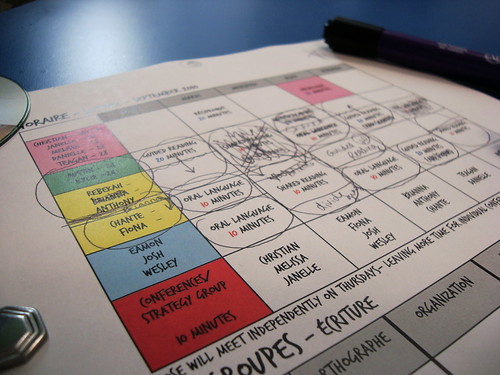
Every morning as a part of our literacy block, we have a Reader’s Workshop. Reader’s Workshop consists of a mini-lesson, small group rotation, independent reading and sharing time.
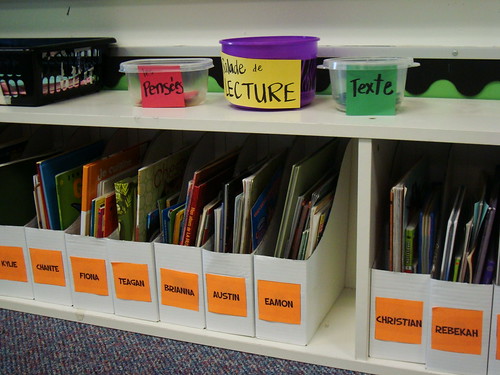
Mini Lesson (5 Minutes): Our Reading Block begins with a mini lesson that lasts approximately 5-7 minutes. Each mini lesson will focus on a reading strategy. There may be times where a strategy will be studied over the course of several days, in which case the mini lessons that week will be related to that strategy.
Rounds 1 & 2 (20 Minutes):
1) Mme Wright will meet with students in two different ways: in a small group or one-on-one
2) While Mme Wright is working with the above students, the rest of the class choses one of the following:
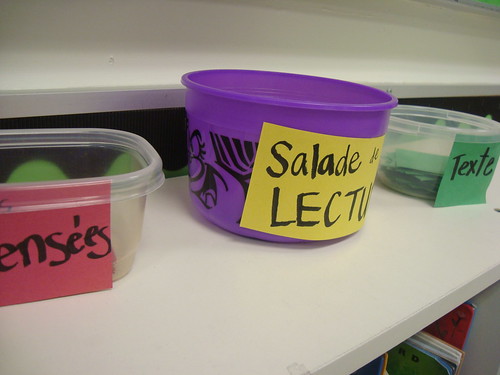
1. Lecture à Soi (read to self): Students practice a skill or strategy from mini-lesson or small group. The best way to become a better reader is to practice each day with a “good fit” book.

(sorry for the creepiness of the blanked out faces)
2. Lecture avec Quelqu’un (read to someone): Read and talk about a text with a self-selected partner. They may be reading the same book or different books. Partner reading provides opportunities to practice strategies, improve fluency, check for understanding, and hear your own voice while sharing.

Lecture avec quelqu'un
3. Écoute (listen to reading): Students listen to books or songs on tape. Hearing fluent and expressive reading expands vocabulary, helps build stamina and makes better readers

Écouter la lecture
4. Les Mots/Grammaire (word work/grammar): Students will work with grammar and words talked about in mini-lessons in a number of different ways, including magnetic letters, white boards and pipe cleaners. Expanded vocabulary leads to greater fluency in reading, therefore increasing comprehension. Becoming a more proficient speller leads to writing fluency and the ability to get your ideas down on paper.

Vocabulaire
5. L’Écriture à propos de la lecture (writing about reading): Students turn in reading response journals each week. They talk about their thinking while they read – and strategies that we’ve been working on. Writing each day makes better writers. Writing about our reading thinking makes better readers.

Écriture à propos de la lecture
Sharing (5 minutes):
During this time the class might: Meet as a whole group to refer back to the mini-lesson and think further; Meet together to think about and respond to questions such as:
What did you learn about reading today?
What did you learn about yourself as a reader?
Meet in small groups to have a quick chat about how the reading is going

Sunday, October 10, 2010

Homework

I dislike homework. Some parents want it, some parents don’t. Some kids complete it regularly, some kids never do. Every year I have tried something different, and I still get the same results. Although our board still says that the expectation is that if you are in grade 3, you do 30 minutes of homework a night, and if you are in grade 4, you do 40 minutes a night, my principal happily approved this letter I sent home to parents last week…. YAY! Not only does it save me time to focus my planning on more “important” things, it also gives students to spend time learning with their families.
The Ontario Ministry of Education has updated it’s provincial Report Card – homework completion has been removed, and incorporated into the Learning Skill of Responsibility. Students are expected to:
  1. Fulfill responsibilities and commitments within the learning environment.
  2. Complete and submit class work, homework, and assignments according to agreed-upon timelines.
  3. Take responsibility for and manage own behaviour.
For nightly homework, students will be assigned special personalized projects throughout the term. It is also the expectation that if a student does not complete an assignment in class**, they will complete it for homework that night. Incomplete classroom work will only be sent home if the student was clearly not using class-time appropriately. It will not be sent home if they do not understand the assignment, or if they worked hard on it in the allotted time.
For regular nightly homework, students and parents are encouraged to
  • READ NIGHTLY!!! Students are expected to be reading every day at home. Have students read to themselves, read to others and be read to (either by an adult, sibling or audio book). Talk to your child about what they have been reading – try practicing the strategies we work on in class. Reading in English at home will help students with reading comprehension, fluency, accuracy and the love of reading. Extra reading (in any language) will strengthen their reading/writing in French. (examples: picture books, novels, magazines, newspapers, online articles, video game instructions, etc.)
  • Write together – Create stories, make books, grocery lists, emails/letters, family newspapers…
  • Play Board Games. Ex) Monopoly (reading, math, estimating, probability, social skills), Scrabble (or Boggle or other word games), etc.
  • Visit the public library
  • Talk about your day, ask each other questions (weekly newsletter might help remind students)
  • Cook or bake together- reading, sequencing, fractions, measuring
  • Do ART together – painting, creating music, dancing, acting games…
  • Play/Work/Spend time in the outdoors – collect things, talk, explore…
  • Explore interesting websites together (try geocaching or learn about a favourite author)
Not only will the above homework ideas increase your child’s achievement at school, they will also be fun, family-oriented and expose your child to a variety of different learning situations.

Wednesday, October 6, 2010

Reading is Thinking

We have been talking about Real Reading. A reader can read the words right and have great expression, but they aren’t real readers unless they are THINKING about their reading. Our first strategy on our reading strategy menu is “arrête et pense” from The Café Book, Boushey & Moser. A lot of my introductory minilessons for metacognition came from Comprehension Connections by Tanny McGregor.
In an email from a parent: when I asked B if she was thinking while she was reading her book last night she said that she only had to do that at school!  Good try silly girl!

Thursday, September 30, 2010

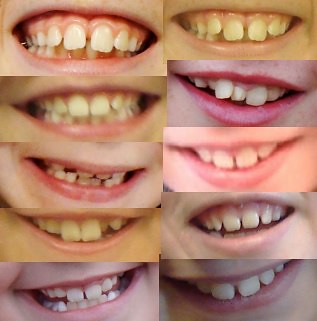
Grade 3 & 4 Teeth

Being the daughter of both a dentist and a dental hygienist, I tend to look at people’s teeth. A lot. I’ve noticed a lot of teeth of 8 and 9 year olds over the past years. Their teeth are the funniest. Their adult teeth have pretty much all come in – and they are rather large, but they just seem too big for their mouths and they haven’t really set. I totally have them in an awkward period. It makes me laugh.
This post is dedicated to the goofy toothy smiles of my grade 3s and 4s over the years.

Friday, September 10, 2010

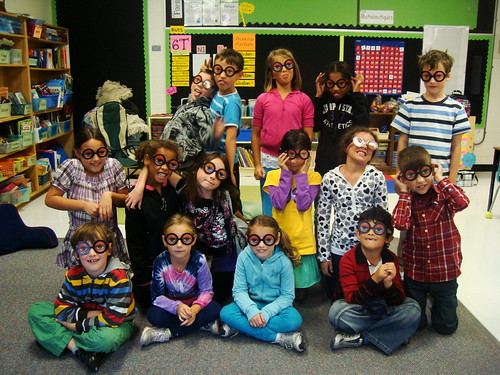
Goofy Glasses

Every year on the first day of school I take a class picture. For the past 3 years, I’ve added the goofy glasses. I love them so much (and so do the kids). And this year was no different. Here’s to a great year!

Tuesday, August 17, 2010

Procedures...

in our classroom, how do we….
answer the phone? behave/sit in assemblies? go to the bathroom? get a drink? eat lunch/snacks? use agendas? use computer lab? use classroom library? listen to instructions? get dismissed? enter/leave the classroom? get attention? react to visitors? act during lit block/math block/etc? walk in the hallway? behave during indoor recess? listen to announcements? manage our lunchboxes? sharpen pencils? know where to sit/work? recycle? work in groups? make up work missed?
I went to school today. They were waxing my floor, so I cannot get in until next week probably. A little behind schedule this summer – new bricks, new walls, new paint job, new windows and SMARTboards for the entire school.
I have a lot of cleaning to do.