Wednesday, January 11, 2012

The Next Chapter


This time last year I was apprehensive of being away from my passion for an entire year. I didn’t want to stop teaching. Teaching inspired me, motivated me, challenged me, excited me and brought out the best of me. It also fostered my creativity and shoved me completely out of my comfort zone. I loved the thrill of a zillion projects on the go and making lists and schedules and newsletters and mini-lessons. I also liked collaborating with teachers and modelling lessons and daily staffroom banter. I knew that I was going to miss it.

The other part of me was giddy to begin my new role as baby maman. I knew that I was going to have a year unlike any that I have had before. And I was right. It started off with a teensy little newborn in my arms and is ending with a baby zooming around the living room and talking up a storm. I couldn’t have imagined today back then. In those early wintery months, I spent days on end in pjs with Eli sleeping on my chest while I watch Saved By The Bell and the Golden Girls. He ate a lot (and we overcame some breastfeeding challenges together), napped infrequently (the bouncy chair was a saviour) and cried if he wasn’t near me.
I found a passion for cloth diapering, grew a collection of wraps/slings/carriers, found a deeper love and appreciation for my hubby, renewed self-esteem about my body (I was proud of my mama doughiness), met best friends through La Leche League and fell in love with sharing a bed with my entire family. We went on picnics, made scenes, went swimming, had playdates, took photos, rode the streetcar, traveled north and south, read lots of books and sang lots of songs, and most importantly formed a trusting relationship with each other.
Like teaching, mothering inspires me, motivates me, challenges me, excites me and brings out the best of me. It has fostered my creativity and shoved me completely out of my comfort zone.
But I think it is time for the next chapter. I feel similar feelings as I did a year ago. I will miss being home with my baby tremendously, but I am giddy to resume my role as Mme Wright. I might not put in as many hours planning for my class as I once did, and I’ll squeeze my extra-curriculars in during recesses instead of after school, but I will have a fresh new perspective in my profession. I think that is a good thing. xo.

“Everything that has a beginning has an ending. Make your peace with that and all will be well.” – Buddha (via a Being Erica episode)

Friday, February 11, 2011

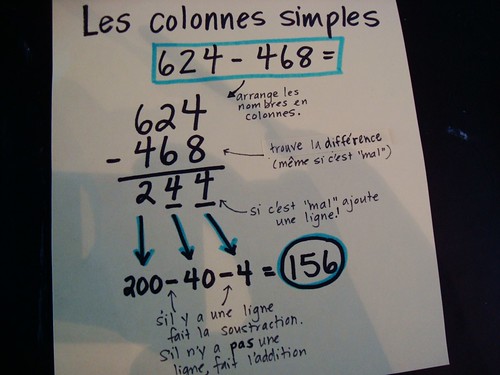
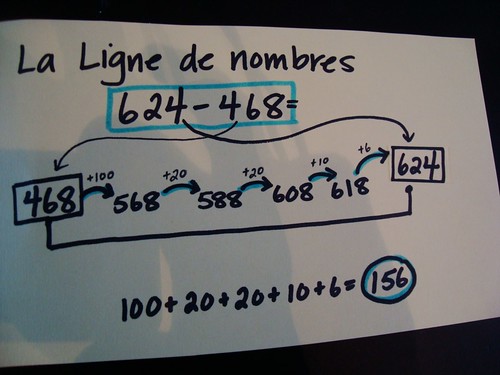
New fave Subtraction Strategy

Thank you Marian Small. This is sooo much faster than the traditional carry-over algorithm for subtraction. I will be using this from now on, if I don’t have a calculator!
I also particularly love the “adding-on” strategy…
And did I mention I only have 4 more teaching days left? And then no classroom for a year. So unreal. woah.

Monday, January 10, 2011

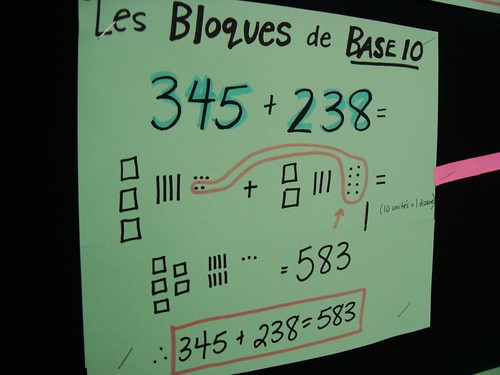
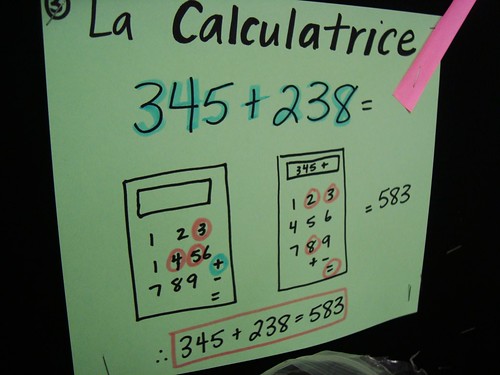
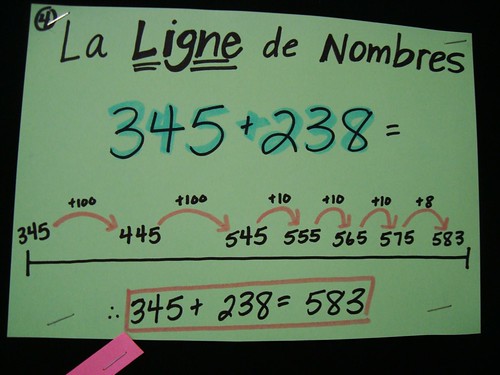
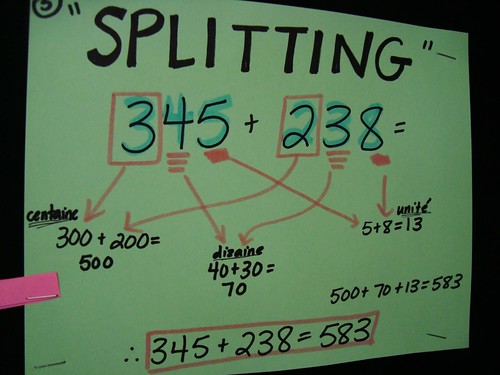
Addition Strategies

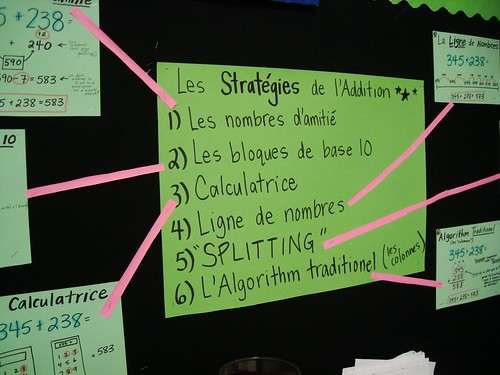
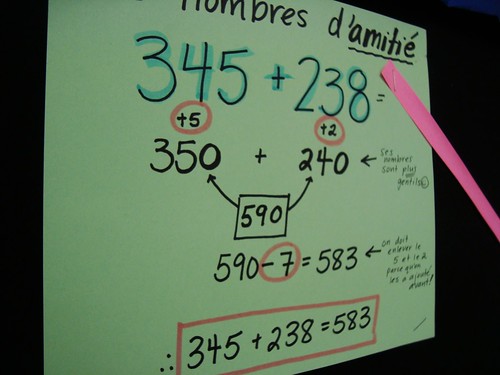
Our addition strategies!
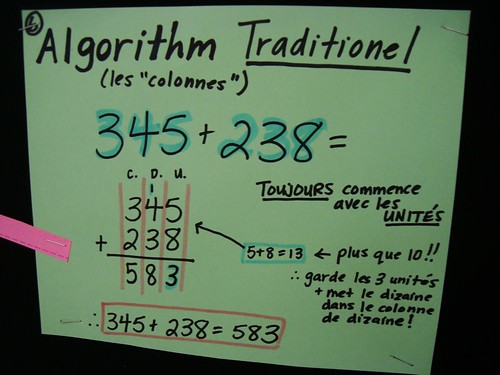
Some may argue that the traditional algorithm is the best and fastest addition strategy- but that is probably because it was the only one that you learned (and were drilled with!). We teach our kids many ways to solve the same question – we also encourage them to come up with their own ways of solving problems. That is what differentiating instruction in math is all about! I don’t care which strategy they end up using to answer their questions as long as they consistently get the right answer and can explain what they’ve done. The splitting strategy is actually very popular for many kids.
We spent this past week learning a different addition strategy and practicing each one. Next week we’ll do more problem solving and they can use whichever strategy they’d like.
The kids are proud that they know how to add in more ways than their parents can. They love playing with numbers in different way. They are like mini-teachers at home. They ask me if I teach them to Rob at home. So awesome.
Check out the six we learned! (yes, me too! I love learning new ways to do old things.)

Friendly Numbers

Base 10 blocks

Calculator

Number Line

Splitting

Traditional Algorithm (the "columns")
For more cool strategies for addition/subtraction/multiplication/division of more than 1-digit numbers, do a youtube search – there are some really rad multiplication strategies out there.
(yes. I love math. And I try to make as many of my kids love it as much as I do!)
NOTE: Please don’t judge me if I’ve made errors. Blame it on the preggo brain!!

Monday, November 1, 2010

Geometry Expectation 2.1

Solve problems requiring the greatest or least number of two-dimensional shapes (e.g., pattern blocks) needed to compose a larger shape in a variety of ways.
Here is a sample week in the life of my math classroom. (It is always changing. My weekly plan this week was quite different than a month ago and might be quite different a month from now.) – see my Math Planning Sheet – based on Mandy Gregory’s. If you’d like to see my (french!) SMARTboard minilessons for the week, please let me know (I can’t seem to upload them here…)
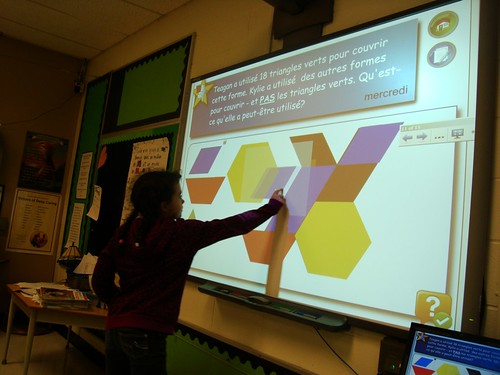
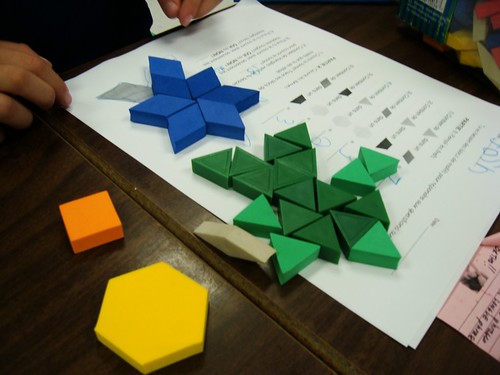
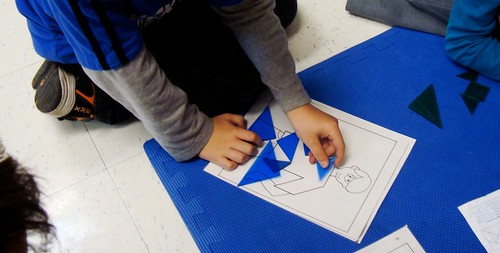
Mondays: Open-Ended Problem based on expectation of the week. This week I translated one of Marian Small‘s problems – Choose any pattern block. Use 20 of the same pattern block to create any shape. Now, choose a different pattern block. How many of this type of block do you need to cover the shape you created?As you can see, this question is extremely open so that all students can have an entry point.
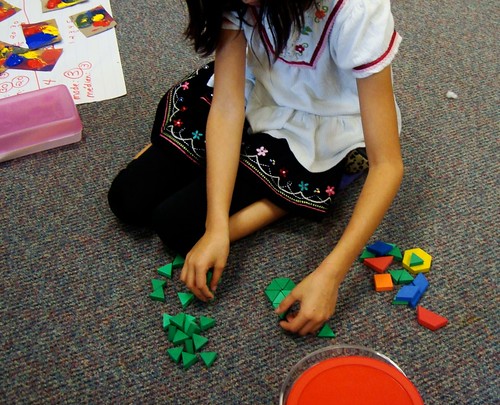
We did an introduction to the manipulatives and reviewed the names of the shapes. Students then split off into teacher-selected partners* to respond to the question on chart paper with markers. After 25 minutes, we gathered together to share our learning. (Based on what I saw, I was able to form my groups for the week). *I choose partners for this activity to so that one person doesn’t do all of the work. I try to match them up with an “equal” partner the best I can.
Tuesdays/Wednesdays/Thursdays: We started with a SMARTboard minilesson to reinforce the curriculum expectation. After 5-7 minutes, we moved into our Guided Math groups. The expectation that I am working on will determine the centre activities the kids do. This week, one centre was working on the NLVM (virtual manipulatives) website creating different 2D shapes with pattern blocks (they have it in French – yahoo!), one was doing paper and pencil practice at their desks (I usually make up my own sheets as the math textbook is a bit too wordy/irrelevent – but sometimes the text) and the other was a tangram challenge with “real” manipulatives. Eventually I would like them to be able to choose which centre they would like to work on, but for now they are on a rotation. The kids do two activities during this block (20 minutes each). At the end, they come back as a whole class and different students volunteer to share their math thinking of the day.
One of the rotations is working with me on the carpet in a small group. For Guided math groups – just like in reading – I make sure I see my lowest group daily (this is usually based on what i see on Monday) – and then plug the rest of the groups in. When working with me, we either work together to build on the skill/concept of the week – this is done with a mini problem, question, activity – usually done orally with a small whiteboard and manipulatives.
Fridays: Independent assessment (taken from EQAO or a parrallel task or a quiz/test) – summative of the expectation of the week to see if they “got it”. This is done completely independently. This week I chose an old EQAO question for them to tackle. – Many of them did well! Yahoo!
The end.
(feel free to give me feedback – or ways to improve!!!)

Saturday, October 30, 2010

French Poems

I am a self-proclaimed “obsessive self-PD’er”. I spend way to many hours learning new things about how to improve my teaching. This may at first seem like a marvellous thing – but in fact, I go a little bit crazy.
This weekend (besides writing progress reports, planning my math week – including creating my weekly SMARTnotebook lessons and open-ended tasks, marking writing and reader’s notebooks, gathering evidence for an IEP, help plan a parent literacy info night, ….) I have decided to research Poetry Workshops.
I have found a number of good blogs with poetry ideas (like this one and this one). I would like to teach them free verse/open prose because I think they’ll be successful, but myself as a student always loved the challenge of following the formula for different types of poems (ie. cinquain, haiku, acrostic, concrete).
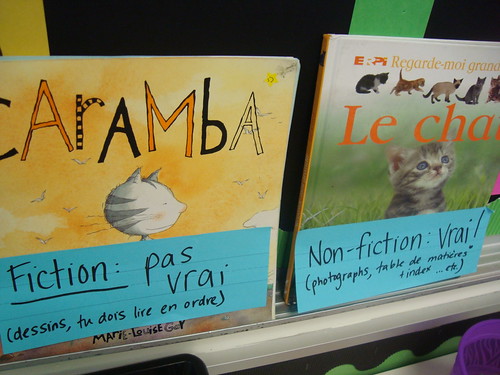
My biggest challenge (as it is with all of my teaching) is that there are wonderful, wonderful mentor texts for poetry and tonnes of websites with great sample poems … in ENGLISH. I have a couple of French poetry books at school, and I have found some basic (and sometimes lame) French poetry sites and I  can copy some song lyrics from my CDs, but it doesn’t compare with the multitude of amazing resources en anglais. I sometimes wish I taught in English for the ridiculous amount of literature there is to use with kids. It would save me a lot of time. You can search for books based on your teaching goal for the day, you can get them from the book room or the school library or the public library and even from a real bookstore (Southern Ontario has a pitiful amount of French books in their bookstores – if any! I either have to order online or drive a few hours). If you wanted to teach a mini-lesson on visualizing or good sentence fluency or inferring, you can refer to a list or a website for a multitude of titles to choose from. In French, I have to read each book I have to see if it *might work for that lesson. <end rant> So…. to TRANSLATE SOME POEMS I MUST GO.

Saturday, October 16, 2010

Reader's Workshop

<another excerpt from my weekly newsletters>
Every morning as a part of our literacy block, we have a Reader’s Workshop. Reader’s Workshop consists of a mini-lesson, small group rotation, independent reading and sharing time.
Mini Lesson (5 Minutes): Our Reading Block begins with a mini lesson that lasts approximately 5-7 minutes. Each mini lesson will focus on a reading strategy. There may be times where a strategy will be studied over the course of several days, in which case the mini lessons that week will be related to that strategy.
Rounds 1 & 2 (20 Minutes):
1) Mme Wright will meet with students in two different ways: in a small group or one-on-one
2) While Mme Wright is working with the above students, the rest of the class choses one of the following:
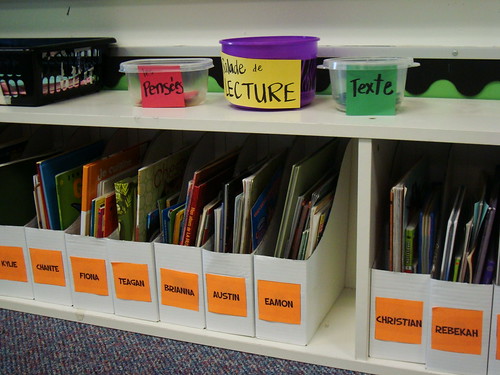
1. Lecture à Soi (read to self): Students practice a skill or strategy from mini-lesson or small group. The best way to become a better reader is to practice each day with a “good fit” book.

(sorry for the creepiness of the blanked out faces)
2. Lecture avec Quelqu’un (read to someone): Read and talk about a text with a self-selected partner. They may be reading the same book or different books. Partner reading provides opportunities to practice strategies, improve fluency, check for understanding, and hear your own voice while sharing.

Lecture avec quelqu'un
3. Écoute (listen to reading): Students listen to books or songs on tape. Hearing fluent and expressive reading expands vocabulary, helps build stamina and makes better readers

Écouter la lecture
4. Les Mots/Grammaire (word work/grammar): Students will work with grammar and words talked about in mini-lessons in a number of different ways, including magnetic letters, white boards and pipe cleaners. Expanded vocabulary leads to greater fluency in reading, therefore increasing comprehension. Becoming a more proficient speller leads to writing fluency and the ability to get your ideas down on paper.

Vocabulaire
5. L’Écriture à propos de la lecture (writing about reading): Students turn in reading response journals each week. They talk about their thinking while they read – and strategies that we’ve been working on. Writing each day makes better writers. Writing about our reading thinking makes better readers.

Écriture à propos de la lecture
Sharing (5 minutes):
During this time the class might: Meet as a whole group to refer back to the mini-lesson and think further; Meet together to think about and respond to questions such as:
What did you learn about reading today?
What did you learn about yourself as a reader?
Meet in small groups to have a quick chat about how the reading is going

Sunday, October 10, 2010

Homework

I dislike homework. Some parents want it, some parents don’t. Some kids complete it regularly, some kids never do. Every year I have tried something different, and I still get the same results. Although our board still says that the expectation is that if you are in grade 3, you do 30 minutes of homework a night, and if you are in grade 4, you do 40 minutes a night, my principal happily approved this letter I sent home to parents last week…. YAY! Not only does it save me time to focus my planning on more “important” things, it also gives students to spend time learning with their families.
The Ontario Ministry of Education has updated it’s provincial Report Card – homework completion has been removed, and incorporated into the Learning Skill of Responsibility. Students are expected to:
  1. Fulfill responsibilities and commitments within the learning environment.
  2. Complete and submit class work, homework, and assignments according to agreed-upon timelines.
  3. Take responsibility for and manage own behaviour.
For nightly homework, students will be assigned special personalized projects throughout the term. It is also the expectation that if a student does not complete an assignment in class**, they will complete it for homework that night. Incomplete classroom work will only be sent home if the student was clearly not using class-time appropriately. It will not be sent home if they do not understand the assignment, or if they worked hard on it in the allotted time.
For regular nightly homework, students and parents are encouraged to
  • READ NIGHTLY!!! Students are expected to be reading every day at home. Have students read to themselves, read to others and be read to (either by an adult, sibling or audio book). Talk to your child about what they have been reading – try practicing the strategies we work on in class. Reading in English at home will help students with reading comprehension, fluency, accuracy and the love of reading. Extra reading (in any language) will strengthen their reading/writing in French. (examples: picture books, novels, magazines, newspapers, online articles, video game instructions, etc.)
  • Write together – Create stories, make books, grocery lists, emails/letters, family newspapers…
  • Play Board Games. Ex) Monopoly (reading, math, estimating, probability, social skills), Scrabble (or Boggle or other word games), etc.
  • Visit the public library
  • Talk about your day, ask each other questions (weekly newsletter might help remind students)
  • Cook or bake together- reading, sequencing, fractions, measuring
  • Do ART together – painting, creating music, dancing, acting games…
  • Play/Work/Spend time in the outdoors – collect things, talk, explore…
  • Explore interesting websites together (try geocaching or learn about a favourite author)
Not only will the above homework ideas increase your child’s achievement at school, they will also be fun, family-oriented and expose your child to a variety of different learning situations.